

By Emma Nnadozie, Crime Editor
In the shadows of Nigeria’s security architecture lies a once-critical but now severely neglected arm of the Nigeria Police Force — the Veterinary Section.
Designed to care for and maintain the health and operational efficiency of police dogs, this department has for years played a silent yet indispensable role in crime detection and prevention across the country.
However, a week-long investigation has revealed a disturbing reality: this vital section has been abandoned for far too long, with dire consequences for the force’s capacity to combat crime.
Police dogs
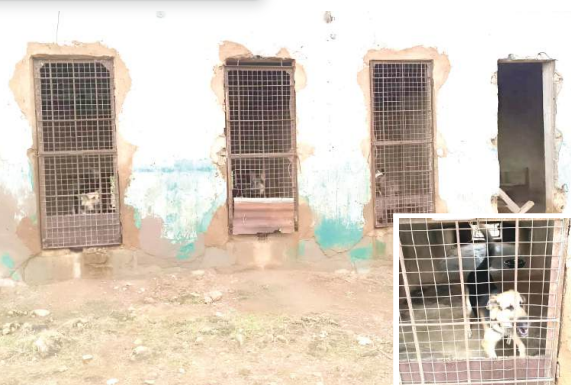
Police dogs — often deployed in detecting narcotics, explosives, tracking suspects, and crowd control — are not mere animals; they are trained assets integral to modern policing. Yet, today, these dogs are languishing in facilities that are fast becoming unfit for any form of habitation. Emaciated, underfed and visibly neglected, the animals are a haunting symbol of institutional failure.
Systemic rot
Checks carried out across several commands show a systemic rot, but the situation in the Ondo State Command is especially alarming. The dog unit there, once active and respected for its contribution to criminal investigations, is now a ghost of its former self. The kennels are deteriorating, the feeding routine has become irregular, and there is virtually no medical attention available for the animals. Sources familiar with the matter attribute this tragic decline to a persistent paucity of funds and a lack of priority from the highest levels of the force’s leadership.
Accusing fingers
Indeed, the finger points squarely at the Inspector General of Police and, by extension, the Federal Government. While the broader Nigeria Police Force grapples with funding and equipment issues, the veterinary section has suffered almost total neglect. Officers within the unit are demoralised, with many reportedly working without the necessary tools, incentives, or even hope of improvement. When contacted for comments, every officer either declined to speak or insisted on anonymity, indicating an institutional culture of silence and fear — perhaps afraid of backlash or further marginalisation.
Stench of decay
This silence, however, cannot mask the stench of decay that now permeates the department. The dogs, once agile, alert and effective crime-fighting partners, now appear worn-out, sickly and withdrawn. The implications for national security are profound. Everyday that this unit is left in disrepair is another day that vital support in criminal investigations is lost — a loss that is ultimately borne by the public.
In other climes
Veterinary care in police systems around the world is regarded as essential, not optional. In countries with well-functioning security systems, dogs are protected, trained and treated as high-value personnel. Nigeria cannot afford to treat these animals otherwise, especially not in the face of rising insecurity, kidnapping, and organised crime. The role of police dogs is not ceremonial; they are often the silent force behind successful arrests, drug seizures and criminal tracking.
Urgent resuscitation
The sentiment out there is that time has come for the authorities to wake up to this ugly reality. The Inspector General of Police must make the resuscitation of the veterinary section a matter of urgent priority. This includes the allocation of sufficient funds, the renovation of existing facilities, the recruitment of trained veterinary staff, and the procurement of quality food and medical supplies for the dogs. The Federal Government must also provide targeted support for the improvement of this unit, recognising its strategic importance.
According to some informed obervers, the continued silence and inaction only serve to deepen the rot. “If Nigeria is serious about reforming its police force and improving its crime-fighting capabilities, then it must begin by fixing even the least visible cracks in the system, ” they argued. One such observer said thus: “The abandoned police dog units are not just a humanitarian concern; they are a national security one. And until the government acts decisively, the country risks losing yet another frontline in the war against crime.”
Reactions of former Inspectors General of Police
Sir Mike Mbama Okiro, the 13th Indigenous Inspector-General of Police, stated unequivocally that the section needs urgent attention because it will contribute much in curbing the prevailing crime situation in the country. According to him: “I revamped the veterinary section. I moved them from Ikoyi to Abuja because they were basically working for the presidency. I also ensured that every unit of the force should have dog section. This is because, there are certain crimes only dog, animals, can detect. Like drugs, for example. I went to the police station in Miami where dogs are trained. You can see the wonders of trained dogs. When dogs are born, their eyes and ears are not open. They don’t see at all. It is smell that they use to know where their mother is. It’s smell they use to recognise their mother’s breast. Nature is wonderful. So, that’s why dogs smell is so strong. They can smell anything.
“I saw that in the police department in Miami, where dogs were being trained drugs. When they are born, they bring drugs to them. And when they smell the drugs, they give them food and biscuits. The ears and eyes are closed while this is going on. The dog is now trained in a way that ifit smells or tastes drugs, it is given something as a reward. So, sometimes they allow the dog to be hungry. It is at this point it is given a drug to smell. And if it passes this test, it will be given food to eat. That is how these dogs are trained.
“There are other crimes you use dog for. Even for armed robbery, they are trained to deflect bullets.
They’re trained that way. I think I saw some dogs trained that way in Japan. I can’t remember the details.
“Talking about the prevailing insecurity in the country, especially kidnapping, invasion of our forests, dogs can be used effectively for that. Trained dogs can achieve a lot and they can help in kidnap cases. If you bring any personal cloth of the victim, dogs will find the person inside the forest. Once they smell it, take them into the forest and they will get the person.”
The 21st Indigenous Inspector General of Police, Baba Alkali, also re-echoed Sir Okiro’s claim that dogs are indispensable tool of fighting crime. He said: “The personnel in that section need training. The dog handler needs to train them in handling the dogs. The personnel in that section that are mounting on the horses need training also. The veterinary clinics require logistics in terms of getting necessary equipment, medical and other things to take care of those animals. It’s about funding. I’m sure at the time I was there the issue of even feeding the animals was a problem because there was no review in terms of what is being provided for the force to feed the animals. And that has been one of the serious problems that brought about the decay of the section.
“We have even a school meant for that in Jos, the Police Mounted School, which is where the dogs are trained. The horses are also trained, the personnel are trained. If you go to that school today, because of lack of funding, it is dilapidated. They also have a critical role to play now that we have the serious problem of insecurity. The dogs can perform very effectively in terms of searches. They are in a position to get incriminating things. They are also very, very good in coding and crowd control. Nigeria is a very wide place with ungoverned spaces. There are a lot of places that you cannot go with machine or motor. In the ’90s, the police made great impact in Polo games. “We had a team that was internationally recognised.
During my time, we even bought horses for them to become regenerated. Our team was well known because we participated actively in international polo games. Maybe you have 10 horsemen armed with their necessary machineries; they can come and search bushes and so forth. So the animal section is still very relevant, only that it is being neglected because of science; but it can still aid science and technology in investigation and other things. They are also being used in ceremonies. They add value, colour and everything. I think it’s a section that needed not to be neglected.”
When contacted over the condition of the police horses, a reliable source at the Force Headquarters, Abuja, told Vanguard: ”Dogs and horses perform different functions. Dogs are majorly for investigations while horses are for ceremonies. Both areas are still grossly neglected”.
The post Neglected and Forgotten: Lamentable decay of the Nigeria Police Veterinary Section appeared first on Vanguard News.