

•Says ‘representation is not representative’
•Insists: ‘We must learn from Sardauna, Azikiwe, Awolowo’
•Marvels that ‘Nigerians excel everywhere except in Nigeria’
By John Alechenu
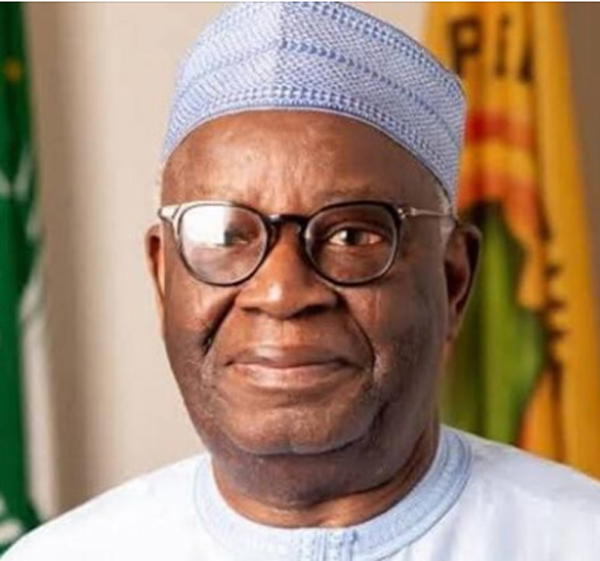
Professor Ibrahim Gambari, retired United Nations diplomat and former chief of staff to late President Muhammadu Buhari, in this interview with Vanguard, stresses the need for an elite consensus to resolve the nation’s political and socio-economic challenges. He also spoke about the contributions of his non-governmental organization, the Savannah Centre for Diplomacy, Democracy and Development, SCDDD, to Nigeria’s democracy.
How do we find a lasting solution to our myriad of national problems?
We must have many national conversations because that’s how you build consensus. And speaking as somebody who has mediated many conflicts all over the world, the secret of a successful mediation talk is to find common ground.
Then, you build on the common ground. You expand the common ground, the areas on which you agree, so that by expanding that, you narrow the areas of disagreement that are inconsolable.
Let me also say, by way of introduction to your questions, that the Sardauna of Sokoto at one time was with his colleagues, Awolowo and Azikiwe, and they were arguing. And then one of them said, “Let’s forget our differences.” He said, “No, no, let’s not forget our differences. Let us recognize our differences and address them and discuss them so that we can now reach a consensus on which to move forward.
So what is lacking, and what Savannah Centre trying to add to the conversation, is to promote conversation to lead to a consensus on which we can build and move our country forward. That is not for the sake of conversation, but one that will lead to elite consensus. There is elite consensus in Singapore. That’s why their society is working.
Forget Asia, look at Senegal. There is a national consensus, elite consensus in Senegal that any president that tries to elongate his time in office against the constitution, they rise as a people and say no.
They said no to Diouf when he tried it and threw him out. They said no to Wade and threw him out. They said no to Macky and threw him out. The second consensus is that they want a democratic process so much so that they agreed that they allow the Ministry of the Interior to conduct elections, because they are all agreed that this is the way to go.
And if you go to Francophone countries, the police are very strong, intimidating. At election time, they vote like everybody else, and they register to vote in a particular polling booth. And if you fail to register because you are posted there, you show your ID and then you are allowed to vote. And the votes are counted at the polling station with all the agents of the political parties present and announced. So, within 30 minutes, you can have the result, the national result, with no question of manipulation or changing the figures from what the voters cast. That’s Senegal.
Don’t wait for another 20 years before we have a national conference or a constitutional conference, so that all these things build up.
We are celebrating over two decades of uninterrupted civilian rule. Is democracy working in Nigeria?
It depends on how we define democracy. What we need is not constitutional change but constitutionalism-a commitment to fair play. Many players don’t want fair play; they want advantage. That’s why it’s not working. Representation is not representative. Inclusivity is missing-youths and women are excluded. That’s not democracy.
How can we curb the practice of elected leaders jumping from one party to another, especially while in office, on the mandate of the party on whose platform they were elected?
One of the most powerful instruments for checking this is simple. You are elected under the platform of one party. If you change, you are free to change, but your seat will be declared vacant. Now, imagine, if we have that in this country. Imagine if these governors knew that the moment they change, there would have to be fresh elections? How many of them do you think will cross the way they are crossing? The absence of consequence is what creates a permissive atmosphere.
In some other systems, if you move after being elected under one platform, your seat is declared vacant and you have to contest again, because otherwise you are living under false pretenses. We elected you under one pretense, and now you have decided to dump it.
So, I appeal once again to you, and I also appeal to myself: let us pay attention to political parties. Because what we have is what we get, and we cannot complain.
How long are we going to keep complaining about the people who rule us when the parties represent nobody in particular and no ideology in particular? So, when they get there, what is the organizing principle of governance, and what are the consequences of deviation?
But there is also the element of greed, because a governor in this country is a very privileged person. What are you looking for? By the time you spend eight years, if you are a God-fearing and moderate person, all your needs will be taken care of. In fact, they have also put enormous pensions for themselves. I do not know whether that is still valid.
On my own pension, I receive N70,000 a month. One bag of rice costs almost that (laughs). Meanwhile, governors determine their own pensions. I served as minister, ambassador, chief of staff, and lecturer. That service was dismissed as “political” and therefore non-pensionable.
I fought not for the money but for the principle that service deserves recognition.
If there is no reward for good behaviour and no punishment for bad behaviour, then the guardrails are off. As human beings, the guardrails are off. So let us study and look at consequences for this kind of behaviour.
To me, the best deterrent is to organise political parties better than we are doing now. You will be proud to belong to a political party that stands for something distinct.
During the First Republic, No Northern Peoples Congress, NPC, person will easily join NCNC in that period. It was clear: one wanted to maintain things as they were, the other wanted change.
But when there is no distinction, who will give us that distinction? The citizens, and of course the leadership. Leaders who believe strongly in something.
For example, Awolowo of the Action Group, AG, believed in a welfare state. Sardauna believed in preserving tradition and managing change through continuity. He stood for local government reform and education. His party believed in that.
That is what I am looking for: parties that have identity and strong leadership.
It was Obama who addressed Parliament in Accra and said Africa does not need strong leaders but strong institutions. You need both. Weak leaders undermine institutions, and leaders who are too strong also undermine institutions.
Leadership must be respected. You must have followers. People believe in what leaders stand for. They stood for something. They had a vision of the future. They had organising principles.
In those days, organising secretaries of parties were powerful. They went to villages, towns, and ethnic unions because they stood for something distinct.
So yes, laws and practices that work, but also leadership and commitment to building parties that stand distinct from each other.
Leadership by example is what is lacking. Not “do as we say,” but “do as we do.”
As a Nigerian who has been privileged to serve in various roles what would you say keeps you awake about our country?
What keeps me awake at night is that according to statistics, Nigeria will be the third most populous country in the world by 2050. Our leaders should be worrying about food security, housing, education, health, power, transportation, and water resources.
In Singapore, when their population was going to rise by 200,000, the whole parliament was alarmed. Here, we add millions and nobody plans.
Yet the opportunities are there: food security, transportation, power, education, health. Nigerians excel everywhere except Nigeria.
Nigerians want to win, but we do not do what makes us win consistently. There is no planning and no consistency.
We must build sustainability for this great country with huge potential but poor leadership due to lack of checks and balances.
Governors collect allocations monthly and people clap for boreholes. That is another problem.
If leaders know we put them there and can remove them, they will act right. If they believe they got there in spite of us, they will not be accountable.
EFCC and ICPC will have limited impact until there is national consensus on what is acceptable.
This is a collective responsibility. Transformation does not happen by accident. There must be consequences.
As a former Chief of Staff, what in your opinion stands an occupant of that office out?
On being Chief of Staff, there was no magic. The pressure on the President is enormous. The Chief of Staff is not a constitutional position. The role is to give loyalty, support, and competence in organising work. I had no political ambition. I was not indebted to anyone. That helped. A Chief of Staff is a reflection of the President’s character. You remain only if you are helpful.
As a former UN diplomat, what are your thoughts about Nigeria’s Foreign Policy?
Foreign policy is not a luxury. It is the articulation of your values and national interest.
Nigeria is the centrepiece of Nigeria’s foreign policy. Relationships radiate from there.
We neglected foreign policy, including funding embassies and appointing ambassadors.
Ambassadorial appointments require acceptance by host countries. That takes time and is not guaranteed.
The post GALE OF DEFECTIONS: Why Nigeria’s democracy is not working, by Ibrahim Gambari appeared first on Vanguard News.