

As Nigeria settles into the pre-election year, under the administration of President Bola Tinubu, 2026 is shaping up to be far more than a routine stop on the political calendar.
It is a hinge year — politically, economically and socially — that will determine whether the country enters the 2027 general elections with renewed confidence or deepening uncertainty.
With major reforms underway, elections on the horizon and public patience wearing thin, the choices made and outcomes recorded in 2026 will significantly shape Nigeria’s trajectory.
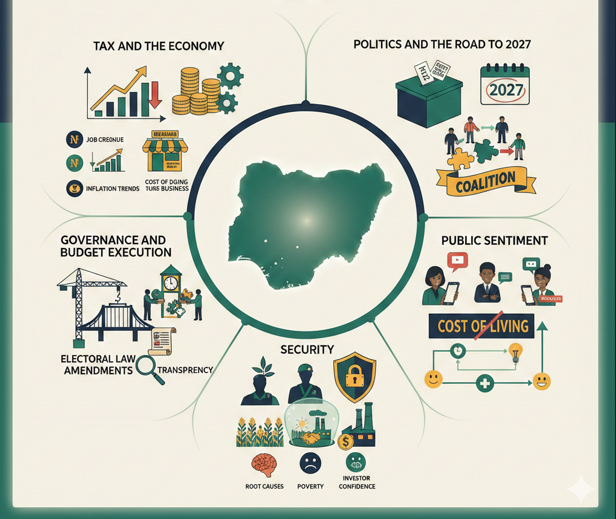
Five broad forces will largely define that direction.
1. Tax and the Economy: Reform, discipline and investor confidence
A key focus for Nigeria in 2026 is putting major tax reforms into action. These changes aim to increase government revenue, make tax collection easier, and cut down on borrowing. After years of financial stress, falling oil income, and rising debt, the reasons for these reforms are obvious. The real question is whether they will be carried out effectively.
In 2026, outcomes will matter more than intent. Fiscal discipline — particularly in budget implementation, debt management and public spending — will determine whether the reforms stabilise the economy or intensify social pressure.
Nigerians are already grappling with inflation and rising living costs. Any perception that taxes are increasing without corresponding improvements in public services could provoke widespread resistance.
Equally important is the investment climate. Policy clarity, regulatory consistency and macroeconomic stability will influence whether domestic and foreign investors regain confidence or remain cautious.
In 2026, economic performance will be judged less by reform announcements and more by tangible indicators: job creation, inflation trends, exchange rate stability and the cost of doing business.
2. Politics: State elections and the road to 2027
Even though 2026 is not a general election year, it is still important politically. The governorship elections in Ekiti and Osun states will show how strong each party is, how voters feel, and which regions have influence. People will watch these elections closely, not just for the results, but to see what they say about public mood after years of economic challenges.
Beyond these elections, political parties will intensify mobilisation, coalition-building and internal repositioning ahead of 2027.
Defections, alliance talks and power calculations are likely to dominate the political space, shaping national discourse and policy priorities. The behaviour of political elites in 2026 — whether they prioritise consensus-building or zero-sum competition — will affect political stability.
The outcomes of the Ekiti and Osun polls could redefine momentum: either consolidating the ruling party’s grip or energising opposition forces seeking to capitalise on public discontent.
3. Governance: Electoral rules, security policy and budget execution
Governance quality will be under intense scrutiny in 2026, particularly in three interconnected areas: electoral administration, security coordination and budget performance.
Proposed amendments to electoral laws and administrative frameworks will test the government’s commitment to credible elections. How these reforms are handled — whether through broad consultation or partisan manoeuvring — will influence public trust ahead of 2027.
Budget execution will also be critical. In recent years, Nigeria’s challenge has not been the absence of plans but the gap between approved budgets and real-world outcomes.
In 2026, attention will focus on whether capital projects are delivered on time, whether social programmes reach intended beneficiaries, and whether ministries and agencies are held accountable for performance.
Security policy is another key test for the government. Better teamwork among security agencies and closer cooperation between federal and state governments will show if policy changes actually make people safer. In 2026, the government’s credibility will depend on real results, not just words.
4. Public Sentiment: Cost of living, taxes and service delivery
Public sentiment will be a powerful undercurrent throughout 2026. Nigerians are increasingly vocal — and digitally organised — around issues of cost of living, taxation and access to basic services. Social media, civil society and organised labour will continue to shape the national conversation.
Reforms that lack clear communication or visible benefits risk public backlash, even if they are economically sound. Conversely, tangible improvements in power supply, transportation, healthcare or education could soften resistance and rebuild trust in government intentions.
In 2026, what people think will matter as much as party politics. How people vote, protest, and accept policies will depend on whether they feel listened to, safe, and treated fairly.
5. Security: Cooperation against persistent threats
Security remains the foundation upon which progress in other sectors depends. Banditry, terrorism, kidnapping and organised crime continue to affect lives, economic activity and investor confidence across the country.
Nigeria’s response in 2026 will depend heavily on national and regional cooperation, intelligence sharing and sustained reforms within the security architecture.
Beyond military operations, success will require addressing root causes: poverty, unemployment, local grievances and weak justice systems.
Progress — or failure — in tackling insecurity will shape everything from food production and school attendance to internal migration and investment decisions. Without measurable security gains, advances in economic reform and governance will remain fragile.
A year that’ll shape what comes next
Ultimately, 2026 is not just another year in Nigeria’s political cycle. It is a testing ground — for reforms, leadership credibility and public resilience. The interaction between tax policy, politics, governance, public sentiment and security will determine whether Nigeria enters 2027 with momentum or apprehension.
The stakes could not be higher. Decisions taken in 2026 will echo far beyond the year itself, influencing electoral outcomes, investor confidence and social cohesion.
For Nigeria, it is a year that will help decide not just who governs next, but how the country is governed — and whether its long-promised transformation begins to feel real to ordinary citizens.
The post Five forces that will determine Nigeria’s direction in 2026 appeared first on Vanguard News.