

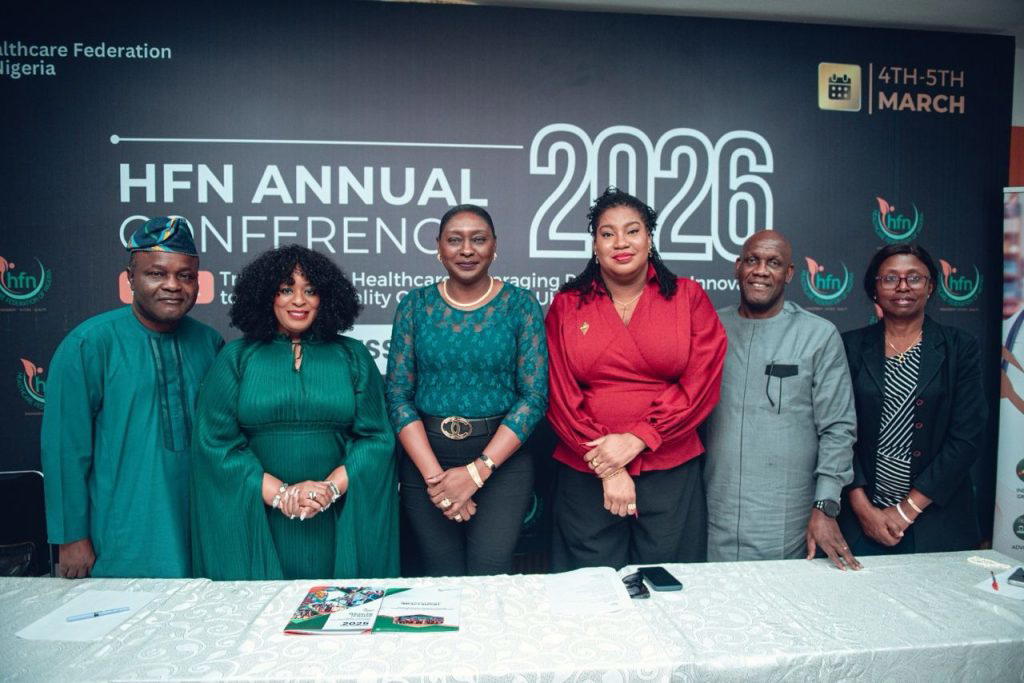
… Holds 4th Annual Conference
By Chioma Obinna
As foreign aid to Nigeria’s health sector continues to shrink and public hospitals struggle to cope, the Health Federation of Nigeria, HFN, has warned that the country’s healthcare system cannot survive without deliberate, full-scale integration of the private sector.
President of HFN, Mrs. Njide Ndili, sounded the alarm in Lagos while announcing the HFN’s 4th Annual Conference scheduled for March 4–5, 2026, saying the moment has come for the government to move beyond rhetoric and formally embrace private healthcare providers as strategic partners.
“With overseas assistance from several countries declining, the onus is now on the private sector to fill that gap,” Ndili said.
“We are not asking for favours. We are positioning ourselves to show what we have done and what we can do, so government can recognise us and bring us in as partners in healthcare policies and programmes.”
Ndili said the Healthcare Federation, a coalition of private healthcare associations and organisations, now carries a significant share of the nation’s healthcare burden, yet remains underutilised in policy implementation.
“Almost 70 per cent of healthcare in Nigeria today is delivered or facilitated by the private sector, yet we are still treated as an afterthought,” she said.
Noting that HFN’s 69-page advocacy report documents sustained engagements with government institutions over the past years, she disclosed that those efforts have begun to yield results, including a signed agreement with the Presidential Initiative on Healthcare covering local manufacturing, capacity building, investment attraction, and technology transfer.
Another breakthrough, Ndili said, is the inclusion of private healthcare providers in the Universal Health Coverage (UHC) Compact signed by all 36 state governors.
“For the first time in Nigeria’s history, private sector providers are legitimately recognised within that framework. This is a huge milestone,” she said.
He cited policy wins driven by HFN advocacy, including the removal of duties on active pharmaceutical ingredients used in local drug manufacturing.
“That decision alone has reduced drug prices,” Akingbade said. “It shows what happens when government listens.”
The HFN conference, which will be held at the Oriental Hotel, Lagos, will feature policy dialogues, investor sessions, innovation showcases, and the launch of a 2026 Healthcare Outlook in partnership with the National Economic Summit Group.
“This is about the survival of the system. Without collaboration, the healthcare crisis will only deepen, ” Ndili said.
On her part, Chair of the Conference Planning Committee and CEO of Infinity Health, Mrs. Irene Nwaukwa, said the conference is designed to force accountability and real engagement between policymakers and providers.
“This is not a talk shop. This is where private providers can look a commissioner of health in the eye and ask: you have announced these policies, when will Nigerians see the results?”
She stressed that reliance on isolated centres of excellence cannot fix Nigeria’s healthcare crisis.
“If you faint in a market, survival depends on the quality of care closest to you, not the best hospital in the city. We all have to grow together.”
HFN Executive Secretary, Mr. Olufemi Akingbade, warned that without access to financing, the private sector’s capacity to scale care will remain limited.
“Healthcare is still wrongly seen as a social service. But it is a business that needs capital. We have over 400 private sector organisations unable to access financing, and that is a serious threat to healthcare delivery.”
The stakeholders also highlighted progress in health insurance enrolment, which has grown from about five million to nearly 20 million Nigerians, but warned that millions remain uncovered.
“The private sector has already unlocked banking and telecoms through innovation,” Akingbade said. “It can do the same for health insurance.”
Also speaking, Chairman of the Guild of Medical Laboratory Directors, Lagos State Chapter, Mr. Adekoya Abimbola Julius, stressed the need for unity and structured collaboration among healthcare providers, saying access to financing must be driven by a collective organisation rather than isolated efforts.
“This year, we must move beyond just talking about money,” Adekoya said. “The first step is bringing healthcare providers together so we can present clear projects and speak with one voice to regulators, banks, and investors. When we are fragmented, it becomes difficult to show what we have to offer or how we can cope and grow together.”
He noted that without coordinated planning and clearly defined proposals, private healthcare providers would continue to struggle to attract investment and institutional support.
“We need to be able to say: this is what we want to build, this is the project, this is the impact. That is how meaningful partnerships and sustainable growth in the health sector can happen.”
Pix caption: L-R: Chairman, Guild of Medical Laboratory Directors, Lagos State Chapter; Adekoya Abimbola Julius; HFN Public Relations Secretary, Mrs. Chinyere Okorocha; HFN President, Njide Ndili; CEO of Infinity Health Chair, Conference Planning Committee, Irene Nwaukwa; HFN Executive Secretary, Mr Olufemi Akingbade; and Deputy MD Society for Family Health & Second Vice President of HFN, Dr. Jennifer Anyanti at a press conference in Lagos.
The post As foreign aid fades, private sector holds key to Nigeria’s healthcare – HFN appeared first on Vanguard News.