

By Henry Umoru
Despite complaints from Nigerians of the nation’s over-borrowing posture, the Senate has said that Nigeria as a country would continue to borrow to bridge its massive budget deficit, even as it vowed to end the long-standing practice of rolling over unimplemented budgets and warned Ministries, Departments and Agencies (MDAs) to brace for stricter scrutiny.
The Senate has also declared that the National Assembly would no longer approve extensions of budget implementation cycles, emphasising that strict timelines, stronger oversight and improved fiscal discipline would guide the execution of the 2026 Appropriation Act.
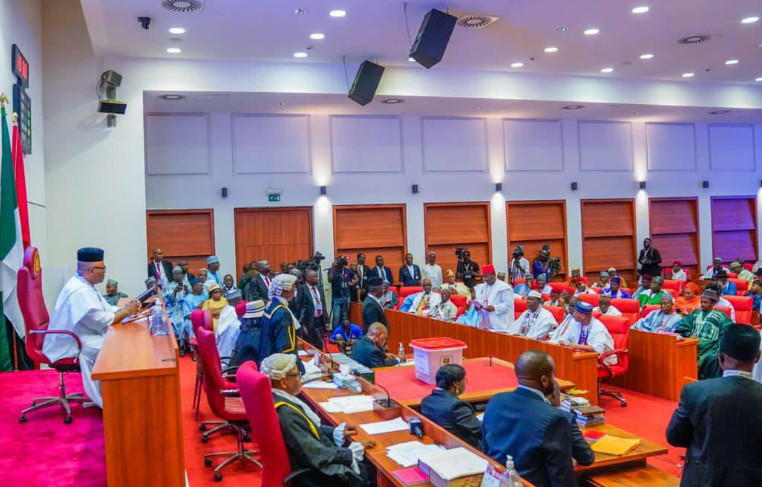
Speaking yesterday in Abuja at a Public Hearing on “The 2026 Appropriation Bill” organised by the Senate Committee on Appropriations, the Chairman of the Committee, Senator Olamilekan Adeola m APC, Ogun West, who noted that borrowing had become unavoidable given the country’s revenue constraints and huge development needs, said, “Never again will the National Assembly approve budget extensions. We must discipline our budgeting cycle, enforce strict adherence to appropriation timelines, and ensure better coordination between policy design and implementation.”
Adeola, who noted that public opposition to borrowing has persisted, said Nigeria’s infrastructure gap and development challenges leave the government with little choice, stressing that the real issue was not borrowing itself but how deficits are financed.
He said, “Nigeria cannot help but keep borrowing because revenue inflows are unpredictable and development needs are enormous. What matters is how we borrow and how we fund our deficits.”
Adeola, who noted that Nigeria must honour its obligations to protect its credit rating and international standing, said, “To avoid crowding out private sector credit, he said government was deliberately limiting domestic borrowing and exploring alternatives such as asset optimisation, privatisation, Public-Private Partnerships (PPPs), joint venture asset leveraging and Eurobond issuances.
“Government is deliberately avoiding excessive domestic borrowing that could crowd out private sector credit. Instead, we are exploring external financing, asset sales and privatisation to bridge revenue gaps.”
On the 2026 budget, estimated at ₦58.47 trillion, Adeola described it as a “Budget of Consolidation,” anchored on subsidy removal, tax reforms, public finance restructuring and electricity sector reforms. He warned that the success of the budget would depend on effective implementation and people-centred outcomes.
He disclosed that projected revenue stood at ₦33.19 trillion, leaving a deficit of about ₦25.27 trillion. Debt service is estimated at ₦15.90 trillion, while capital expenditure of ₦23.21 trillion reflects the government’s focus on infrastructure and productivity.
Key assumptions include an inflation target of 16.5 per cent, an exchange rate stabilised around ₦1,400 per dollar, oil production of 1.84 million barrels per day, and a benchmark oil price of $64.85 per barrel. Priority allocations include ₦5.41 trillion for defence and security, ₦3.56 trillion for infrastructure, ₦3.52 trillion for education and ₦2.48 trillion for health.
Adeola warned heads of MDAs to take budget defence seriously, noting that failure to justify proposals could lead to reallocations. He also reaffirmed that all government funds, including service-wide votes, remain subject to legislative oversight.
On his part, an Economist and fiscal policy expert, Dr. Olatilewa Adebanjo, who warned that Nigeria’s rising budget deficit could become unsustainable without urgent reforms in revenue mobilisation and fiscal discipline, however, called for a comprehensive review and stricter enforcement of the Fiscal Responsibility Act (FRA), describing it as a potent but underutilised law.
He said, “We need to remain alert and proactive. All stakeholders must closely monitor critical sectors to ensure revenues meant for the government actually reach government coffers.”
The Economist, which raised concerns about the mining and solid minerals sector, alleging massive revenue leakages, however, accused foreign interests, especially Chinese firms, of extracting Nigeria’s resources with minimal benefit to the country.
He said, “What we continue to see is a situation where foreign actors, especially Chinese interests, come into the country, extract our mineral resources and leave with enormous value, while Nigeria earns little or nothing in return. This is a wake-up call.”
Adebanjo also criticised what he described as unrealistic revenue projections, urging the government to base budgets on achievable figures and hold revenue-generating agencies accountable for performance.
In his remarks, the Accountant-General of the Federation, AGF, Shamseldeen Ogunjimi, has taken a swipe at the country’s budgeting system, saying that for too long, Nigeria has been strong on budget formulation but weak on budget translation.
Ogunjimi said that “budget is not a spreadsheet; it is not a ritual of numbers; it is not merely an annual legal requirement.
“A budget is a moral document. It tells us clearly and without excuse who we prioritise, what we value, and how seriously we take the future of our people.
“For too long, Nigeria has been strong on budget formulation but weak on budget translation”.
According to him, budget implementation must move beyond paperwork, adding that this was where legislative oversight must evolve, just as he called on the committee to insist on clear performance indicators from Ministries, Departments and Agencies (MDAs).
The Accountant-General of the Federation said, “We have operated in trillions, yet billions we ask, where are the roads, where are the hospitals, where are the jobs, where is the impact. The theme of this year is from budget to impact.
“The 2026 budget is a defining moment. The 2026 appropriation bill arrives at a defining moment in our national journey. Beyond a rapidly growing population demanding opportunity, not excuses; tight fiscal space; and rising debt service obligations, time and stress are affecting food security and livelihoods.
“Citizens who are more informed, more focused, and less patient with waste in this context. The question, therefore, before us is no longer how much we are allocating. The real question is: what changes in Nigerians’ lives result from these allocations?
“The serious question is, impact begins when we shift our mindset in really critical ways. From inputs to outputs, we must stop measuring success by the number of older or new visits, the size of allocations, or the speed of budget passage, and start measuring success by classrooms actually functioning, healthcare centers actually starting, power actually delivered, and jobs actually created.
” If a budget cannot clearly answer who will benefit, how and when, it should not survive appropriation. Too many budgets strike limited resources across too many small, unfunded budgets, creating visibility without viability.
“Impact requires, therefore, prioritization over proliferation, completion over commencement, depth over political dispersion. Finished projects change lives while abandoned ones decorate reports.
“From compliance or accountability, budget implementation must move beyond paperwork. Through accountability, we ask, Was the budget delivered? Did it meet standards? Did it solve the problem it was meant to solve? This is where legislative oversight must evolve.
“From episodic inspections to impact-driven scrutiny. This public hearing is not a formality. It is a powerful democratic tool.
“Here, the Senate gives voice to citizens. It interrogates assumptions and aligns national priorities with lived realities.
“I call on this committee to use this platform to insist on clear performance indicators from MDAs, realistic timelines, and transparency in costs assumptions. Alignment with national government plans. Let us make it clear, Appropriation without implementation is a failure Implementation without impact is a waste.
” At the centre of the 2026 budget is the Nigerian citizen as a stakeholder. A barber does not treat the budget as a capital expenditure; a mother does not treat the budget as recurrent spending.
“A young graduate does not experience budget as a fiscal consultation, he expects it as food on the table medicine in the living, light in the home, dignity in work.
“This is the standard by which this budget must ultimately be done. Moving from budget to impact is not the job of one arm of government alone. The executive must plan and implement with discipline. The legislature must appropriate and oversee with courage.
“MDAs must execute with competence. Citizens must engage and demand results. History will not remember how quickly we passed the 2026 budget. It will remember what the 2026 budget changed.
“Let us choose impact over initiative, results over rhetoric, and legacy over convenience. Let the 2026 Appropriation bill be remembered as where we kept action budget became services, promises became progress.”
Declaring the hearing open, the President of the Senate, Senator Godswill Akpabio, said that budget hearings were not mere rituals of governance but moments of national self-examination.
Represented by the Deputy President of the Senate, Jibrin Barau, APC, Kano North, said that “Nigeria today stands at a decisive crossroads.
“We confront fiscal pressure, inflationary strain, gaps in infrastructure, anxieties of employment, and security challenges that weigh heavily upon the confidence and livelihoods of our people.
“These are not abstractions. They are not theoretical projections. They are the daily realities felt in homes, markets, farms, factories and streets across our land”.
Akpabio, who noted that the task of the national assembly was not simply to spend more, but to spend better, said, Not merely to allocate funds, but to convert budgets into outcomes and appropriations into impact.
“We will continue to work with the Executive and all stakeholders to ensure that the 2026 Budget is not only passed on time, but implemented with fidelity and measurable results.”
The post Nigeria will continue borrowing to fund N25.91trn budget deficit, Senate declares appeared first on Vanguard News.