

Worried by the continuous use of large expanse of lands for illicit drugs, especially for the use of cannabis cultivation, the National Drug Law Enforcement Agency (NDLEA) initiated a programme which would see the conversion of these lands to agricultural farms. In this report, EJIKE EJIKE writes about the project and the development so far
The 2018 National Drug Use Survey, which is the latest survey in use, showed that about 14.4 million Nigerians, one in seven adults, use drugs, a trend that fuels crimes ranging from kidnapping to terrorism.
The chairman and chief executive of the NDLEA, Brigadier General Mohamed Marwa (rtd) said in the past five years, the NDLEA has seized about 12 million kilograms of cannabis nationwide with a significant of that proportion traced to Ondo State. The NDLEA recently launched its Alternative Development Initiative, aimed at converting the large expanse of land used for illicit drug production into farmland.
Speaking at the event, Marwa said in Ondo State alone, drug use prevalence stands at about 17 per cent, translating to roughly 400,000 users. This is despite Ondo’s status as Nigeria’s leading cocoa producer. Marwa observed that the state is also the country’s highest producer of cannabis, and hence, the need to kick off the pilot stage of the initiative in the state.
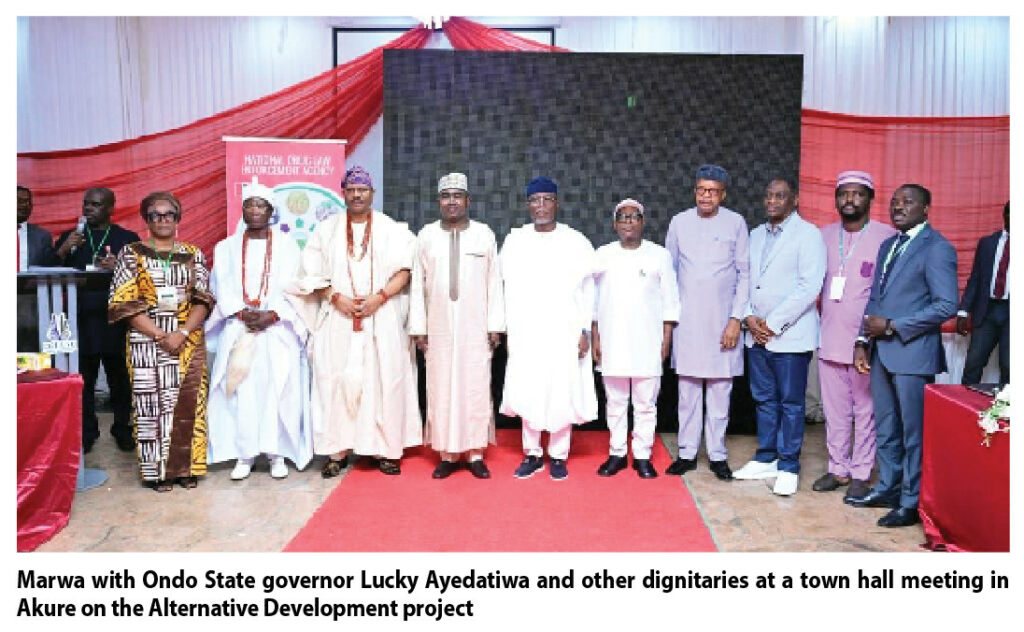
The Programme, he explained, is designed to help communities voluntarily abandon illicit crops such as cannabis and transition to legitimate alternatives, including cocoa, cassava, yams and beans. Ondo State was selected for the pilot phase because of its prominence in cannabis cultivation.
Addressing stakeholders at a town hall meeting, Marwa, who described the initiative as a decisive shift from a purely enforcement-driven approach to one rooted in empowerment and partnership, noted that
“Alternative development changes our relationship from enforcement to empowerment. We want a total shift from illicit cropping to productive cash and food crops.”
Marwa further stated that the initiative is not a pretext for arrests; rather, it is a collaborative effort supported by the federal government, the United Nations and other international partners, with strong emphasis on community ownership and sustainability.
The governor of Ondo State, Lucky Orimisan Aiyedatiwa, called for comprehensive and people-centred strategies to tackle drug abuse, urging young people to reject illicit substances and embrace alternative livelihoods.
He described the NDLEA initiative as timely and visionary, noting that drug abuse remains a serious threat to public health, social stability and economic productivity, often fuelling crime and youth unrest.
According to the governor, tackling the root causes of poverty, unemployment, and lack of opportunity is far more effective than relying solely on enforcement.
He said, “When people are productively engaged, the urge to indulge in drug abuse and other illicit activities is significantly reduced”, while highlighting his administration’s investments in skills acquisition, agriculture, vocational training and youth-focused grants.
He assured the NDLEA of the state government’s full support, pledging collaboration with traditional rulers, religious institutions, civil society organisations and the private sector to strengthen prevention, rehabilitation and reintegration efforts.
Also, the minister of Agriculture and Food Security, Senator Abubakar Kyari, represented by the ministry’s South-West Regional Director, Mrs Temitayo Alao, commended the initiative, describing it as a direct response to hunger, poverty and unemployment among vulnerable populations.
He noted that the programme aligns with President Bola Ahmed Tinubu’s Renewed Hope Agenda by promoting food security and job creation.
The International Institute of Tropical Agriculture (IITA), Ibadan, through its deputy director-general for Partnerships, Dr Tahirou Abdoulaye (represented by Dr Noel Mulinganya), described the pilot project as timely and impactful, capable of addressing the vulnerabilities that push communities into illicit economies.
The monarch in Ilu-Abo, one of the communities that will benefit from the programme, Oba Samuel Oluyemisi, praised the initiative as a product of “deep and creative thinking.”
He noted that while traditional efforts had reduced illicit cultivation, economic hardship had pushed some youths into crime.
“If they are given alternative engagement, they will have no interest in crime or drug production,” Oba Oluyemisi said, pledging total support for the programme.
A staff member of the International Institute of Tropical Agriculture (IITA), Noel Mulinganya, applauded the collaboration in the planting exercise and supported the NDLEA, the state government, and the host community in initiating the project.
He expressed his admiration for the NDLEA’s efforts to attract more youths away from illegal activities and engage them in agriculture.
According to him, IITA has a strong programme focused on youth engagement in agriculture to promote wealth and job creation. He noted that IITA is committed to supporting the NDLEA by transferring relevant technologies, knowledge, and skills to help youths and other members of the community understand the benefits of agriculture, enabling them to build sustainable livelihoods beyond illegal activities.
To ensure the programme’s success, Marwa announced financial support for the communities involved in the pilot stage, with N15 million for Eleyeowo and N20 million for Ifon to kick-start lawful farming and other productive ventures.
Calls For National Response, Support For Alternate Development Programme
Meanwhile, the NDLEA chairman has called for a strong national response and sustained support for the alternative development programme to succeed.
He said the alternative development programme, the Africa drug control initiative, was unveiled to curb illicit cannabis cultivation, uplift rural communities and strengthen national security.
Speaking at a press conference in Abuja on Tuesday to drum support for the initiative, Marwa said the concept goes far beyond crop substitution, stressing that “its wider benefits include: strengthening rural economies through value-chain development; reducing the burden on law enforcement and the justice system; promoting peace and social cohesion in previously crime-prone areas; supporting national food production and agricultural diversification; improving Nigeria’s international standing in global drug control and development cooperation.”
Marwa further added that, “this approach represents a win-win solution—for communities, for government, and for national security. The successful take-off of the pilot scheme in Ilu Abo, Ifon, and Eleyewo in Ondo State last week clearly demonstrates that alternative development works when communities are engaged, supported, and empowered.
“We therefore called for a strong national response and sustained support from all stakeholders across all layers of government, traditional rulers and community leaders, development partners and donor agencies, the private sector and agricultural value-chain actors, as well as civil society organisations and the media.”
He also urged communities across the country, particularly those affected by illicit drug cultivation, to embrace the model and work with the NDLEA in building lawful, productive, and secure livelihoods, noting that “Let me reiterate that the alternative development programme is not just a drug control initiative; it is a people-centred development intervention designed to uplift communities, strengthen national security, and secure Nigeria’s future.”
He assured that the NDLEA “remains fully committed to expanding this programme nationwide, in partnership with all stakeholders, as we collectively build a safer, healthier, and more prosperous Nigeria in alignment with the renewed hope agenda of the President Tinubu administration.”
Speaking on the successful flag-off of the scheme in Ondo State, Marwa said, “One of the most encouraging outcomes of this pilot project has been the overwhelming acceptance and support expressed by the host communities and their traditional and community leaders. They have openly stated that this programme has renewed their hope in Nigeria and restored their confidence in the government.
“They recognise that alternative development offers a dignified and lawful source of income for farmers; reduction in poverty and vulnerability, especially among rural households; improved food security through the introduction of viable alternative crops; enhanced community stability and safety, as illicit drug cultivation often fuels criminal networks and insecurity.”
He noted that replacing cannabis cultivation with sustainable agricultural and economic opportunities, the programme directly tackles the root causes of drug production rather than merely treating the symptoms.
Many residents denounced their involvement in illicit drugs and declared their support for the programme.
A 46-year-old farmer, Mrs Bridget Olaoluwa, from Eleyeowo, admitted she had been involved in illicit farming since her youth and pledged to abandon the practice and invest in a legitimate business if supported.
Another farmer, Mr Victor Ajanaku, 50, described the initiative as an eye-opener. “For the first time, I see NDLEA personnel not as enemies, but as partners in progress,” he said, urging transparency to ensure that promised funds reach genuine beneficiaries.