

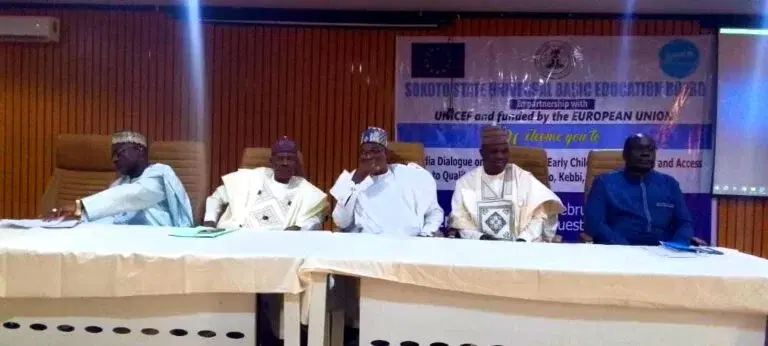
The Sokoto State Universal Basic Education Board (SUBEB) has intensified efforts to address the rising number of out-of-school children through expanded Early Childhood Care and Education (ECCE) and strategic reforms, the Executive Chairman, Umar Tambuwal, said.
Tambuwal spoke at a media dialogue on educational reform and out-of-school children for Sokoto, Kebbi, and Zamfara States.
He described education as central to the state’s future and stressed the need to invest in early childhood development to reverse poor educational outcomes.
He noted that the period from birth to age eight was crucial for brain development, cognitive growth, and emotional stability, emphasising that quality ECCE was essential, particularly for disadvantaged children.
Tambuwal warned that lack of early learning opportunities fuelled school dropouts and out-of-school children, noting that with UNICEF support, SUBEB aided 160 ECCE centres in 2024 and 2025 with teaching materials and caregiver training.
He added that UNICEF committed to supporting 80 more centres, while SUBEB planned to triple the number in 2026.
He acknowledged the challenge, revealing that 66.4 per cent of school-aged children in the state were currently out of school.
The chairman said the government had documented about 25 per cent of those children for reintegration through a mapping exercise across 23 local government areas, targeting vulnerable groups including girls, orphans, and Almajiri pupils.
He highlighted that the government had made basic education free and compulsory, abolished school levies, prioritised teacher recruitment, and launched initiatives like the Digital Village to equip Almajiri children and out-of-school girls with digital skills.
Tambuwal disclosed that the AGILE Project provided infrastructure grants to 240 secondary schools to improve learning environments and enhance educational outcomes across the state.
He added that integrated schools in Shuni, Gagi, Tambuwal, and Wamakko combine Qur’anic education with literacy, numeracy, vocational training, and offered free accommodation and feeding for students.
He said three mega model schools were being established across the senatorial zones: Aliyu Magatakarda in Wamakko, Muhammad Sambo in Goronyo, and Government Day Junior Secondary in Tambuwal.
According to him, each school will have 60 classrooms, science laboratories, playgrounds, and will be staffed with qualified teachers carefully screened from a pool of 3,000 candidates.
Tambuwal noted that the state’s Out-of-School Children dashboard captured 326,119 children between 2024 and 2025, calling on the Federal Government and Universal Basic Education Commission to replicate the model nationwide.
“Educating every child is not just a development goal; it is a moral imperative and a cornerstone of national security,” he said.
He also urged media support for proposed legislation on Almajiri reform and revival of school feeding programmes.
Dr Michael Juma of UNICEF commended the Sokoto government and emphasised the media’s role in promoting early childhood education, digital empowerment, and enrolment awareness.
Also speaking, the Sokoto State Governor’s wife, Fatima Aliyu, reaffirmed her support for inclusive education, advocacy, and strategic partnerships to reduce the number of out-of-school children across the state.
She was represented at the event by the Commissioner for Basic and Secondary Education, Ala Ahmed, who emphasised the need to prioritise education for girls and other vulnerable groups.
The News Agency of Nigeria reports that the two-day workshop was organised by the Sokoto State Universal Basic Education Board in partnership with UNICEF and funded by the European Union.
NAN also reports that participants included staff of SUBEB, Non-Governmental Organisations (NGOs), Civil Society Organisations (CSOs), government officials, and media personnel from Kebbi, Zamfara, and Sokoto States.
The post Sokoto Govt, UNICEF intensify efforts to reduce out-of-school children appeared first on Vanguard News.