

By Luminous Jannamike, ABUJA
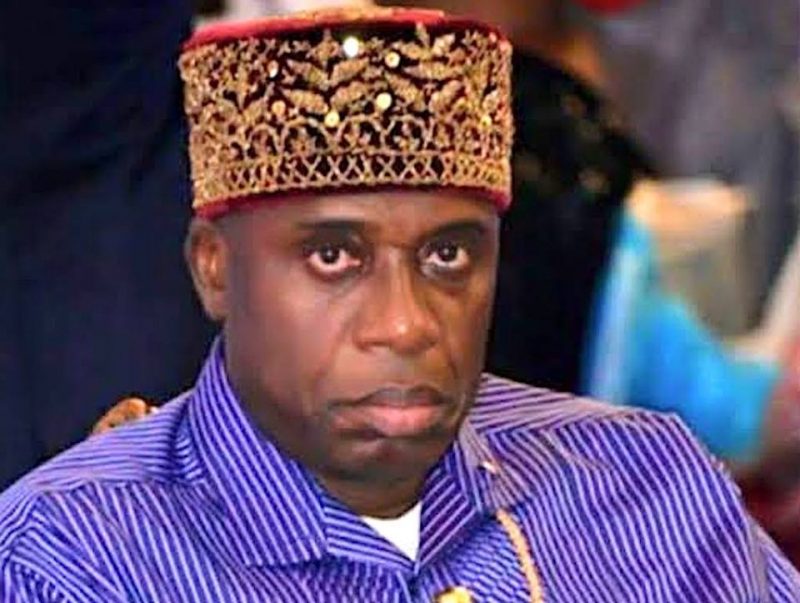
Last Tuesday, the morning heat had not yet settled over Abuja when former Rivers State governor and ex-Minister of Transportation, Rotimi Amaechi, stepped onto the protest ground at the National Assembly, his son walking quietly beside him.
Placards demanding electronic transmission of election results swayed in the air. Lawmakers hurried past security barricades. Journalists adjusted their cameras. But amid the chants and speeches, it was the image of father and son standing together at the center of political tension that lingered.
Responding to critics, Amaechi addressed why his son was present: “There are those who say politicians call for protests while their children are abroad. Here is my first son. I brought him to join this protest. He is a medical doctor and his responsibility is to attend to anyone who may be injured.”
Supporters saw a father countering accusations of hypocrisy. Yet others said they took the explanation with a pinch of salt.
In Nigeria’s political culture, early exposure to high-level events often signals more than observation; it can mark the quiet beginning of a political journey.
“Many of us came here believing our voices would matter. But when you stand here and watch who already walks in and out of these places like they belong, you start to realize something, some people were born into this access. For the rest of us, we’re still trying to find the door,” said a protester standing near the barricades.
Abuja: Where Access Shapes Ambition
In Abuja, proximity to power is currency. Being present at decisive moments builds networks that shape futures. The nation’s capital is not just where laws are passed; it is where influence is cultivated.
Across Nigeria, similar patterns are visible. Children of prominent politicians appear at official engagements, accompany state visits, and later emerge as candidates. What is publicly framed as mentorship often evolves into structured succession.
In Kwara, the political network built by former Senate Leader Olusola Saraki, widely known as Baba Oloye, sustained a powerful family influence that shaped the state’s politics for decades, eventually paving the way for his son, Bukola Saraki, to serve two terms as governor before later rising to become Senate President following his father’s demise.
In Ebonyi, the son of Works Minister Dave Umahi recently entered grassroots politics after securing a local government party ticket, further fueling debates about how political power moves from one generation to another.
Still, these succession plans do not always succeed. At different moments, voters have pushed back against long-standing political families, showing that dominance is never completely guaranteed. The 2019 political upset in Kwara, driven by the “O to ge” (Enough is Enough) movement, dismantled decades of entrenched control, proving that while dynasties can last for years, they can also collapse quickly when public frustration finally turns into organized electoral action.
In Kaduna, the son of former governor Nasir El-Rufai moved from working as an adviser during his father’s administration between 2015 and 2023 to winning a seat in the House of Representatives, a transition many Nigerians say reflects how political exposure can open doors early.
In Rivers and Abuja, the growing public visibility of the son of FCT Minister Nyesom Wike at official events has also sparked conversations about early grooming for leadership.
At the national level, the frequent presence of Seyi Tinubu, son of President Bola Tinubu, at major engagements continues to generate debate about where family association ends and political influence begins.
The pattern extends beyond one party or region. In Kwara, the political structure built by the Saraki family elevated Bukola Saraki from governor to Senate President, reinforcing perceptions of dynastic continuity.
When Politics Feels Inherited
For many young Nigerians without established surnames, entering politics can feel like arriving at a closed gate. Party meetings are attended, communities mobilized, and resources pooled /, yet final tickets often appear predetermined.
Political scientists warn that entrenched dynasties can narrow internal party democracy and discourage capable newcomers. When access to funding, endorsements, and structures repeatedly circulates within a few families, elections risk becoming contests among established networks rather than open competitions of ideas.
Defenders argue that children raised in political environments naturally develop leadership skills. Exposure, they say, does not automatically equal entitlement. Critics counter that when exposure is combined with inherited influence, the playing field tilts.
Public Reaction
Human rights defender Joseph Ikechukwu Nwakaibeya said: “While it’s true that the late General Muhammadu Buhari may not have met the full expectations of Nigerians in terms of governance, one thing that cannot be denied is the discipline and restraint he showed in keeping his family away from the affairs of government. That in itself is a rare display of principle in our political space.
“Unlike President Tinubu whose administration has been plagued by allegations of nepotism and excessive family influence from his son, Seyi Tinubu, riding on government resources, to the growing visibility of family members in state matters, Buhari maintained a clear boundary. His children were not parading power or flaunting privilege.
“This contrast tells a deeper story about character and legacy. You may disagree with Buhari’s policies, but at least he upheld a certain code. Tinubu’s government, on the other hand, feels more like a family empire than a public institution.
“Leadership is not just about political strategy; it’s about discipline, integrity, and knowing when to draw the line. Nigerians see the difference.”
Public affairs commentator Oluwatobiloba Adebayo said:
“They know we’re not ready to reason. That’s why they keep grooming their own children for leadership positions while the rest of us are busy arguing about tribe and religion on X.
“Look at Wike. Anywhere he goes, his son is right there beside him. Press conferences, official visits, closed-door meetings, the boy is always present. You think that’s by accident? No. He’s showing him how Nigeria is ruled and governed. He’s giving him access, connections, and insider knowledge.
“This is why nothing changes in Nigeria. Because leadership isn’t a competition. It’s an inheritance. And while we’re busy being divided, they’re busy being deliberate.”
The Question That Lingers
As the protest wound down and traffic resumed around the National Assembly, one image remained: a father and son standing at the edge of power.
It was not dramatic. It was not loud. But it captured a deeper anxiety; whether Nigeria’s democracy will widen its doors, or whether access to leadership will continue to feel like something passed down rather than openly won.
The post 2027: Rotimi Amaechi, his son, and politics of inheritance appeared first on Vanguard News.